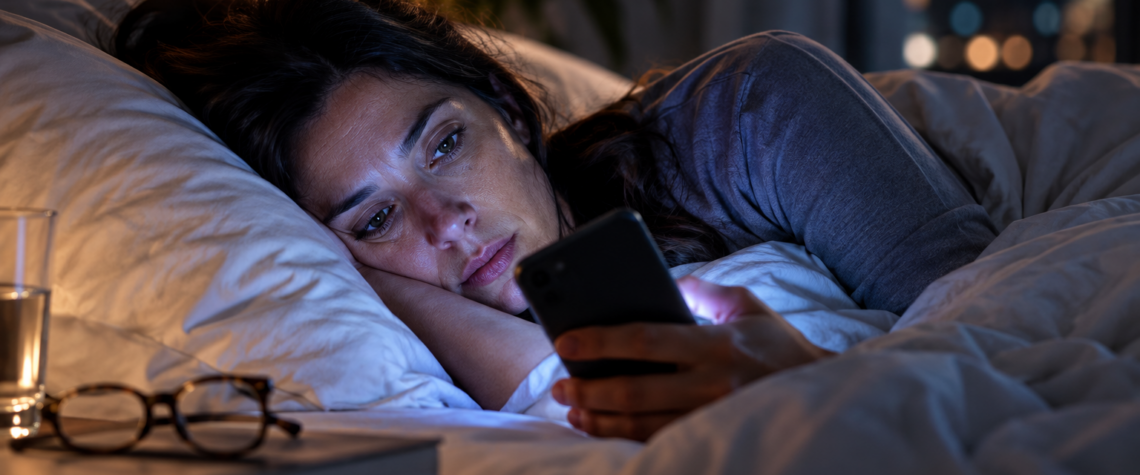
The smartphone has become our alarm clock, television, newspaper and constant companion. But what happens when the last thing we see at night is also the first thing we reach for in the morning? For millions of people, bedtime now has a familiar ritual. Turn off the lights. Get into bed. Pick up the phone. One video becomes three. A quick look at the news turns into twenty minutes of scrolling. A message arrives. Then another notification. Before we realize it, the device that was supposed to wake us in the morning has helped keep us awake at night. The smartphone has conquered one of the last quiet places in modern life: the bedroom.
It isn’t only about the screen
Much of the discussion about phones and sleep has focused on the light produced by screens. But there is another problem that may be just as important. Phones are designed to keep us engaged. News, messages, games, social media and videos give the brain reasons to remain interested at precisely the moment when we are trying to disengage from the day. The problem isn’t simply that we’re looking at a bright screen. It’s that there is always one more thing to see.
The alarm clock that never sleeps
There was once a useful distinction between an alarm clock and the rest of the world. The alarm clock sat beside the bed and did almost nothing. A smartphone sitting in exactly the same place contains your email, photographs, news, social networks, entertainment, work and conversations with people around the world. Even when the phone is silent, we know all of that is waiting a few inches away. That can make a simple habit surprisingly difficult: putting it down.
Technology can also help
The irony is that the same device disrupting our sleep can also help us protect it. Most modern smartphones include tools that can reduce notifications, limit interruptions or automatically change how the phone behaves during certain hours. Sleep schedules and “Do Not Disturb” or focus modes can create a digital boundary around bedtime. But those features only work if we allow them to. Technology cannot create a boundary that we repeatedly choose to cross.
Try changing the geography
One of the simplest solutions may have nothing to do with software. Change where the phone sleeps. Instead of keeping it beside the pillow, place it across the room. Better still, charge it somewhere outside the bedroom if that works for your routine. If you use your phone as an alarm clock, an inexpensive traditional alarm clock can perform that job without offering news, email or social media at 2 a.m. The goal isn’t to declare the smartphone an enemy. It’s to make reaching for it slightly less automatic.
Pay attention to the first five minutes
There is another revealing moment in our relationship with phones. Morning. What is the first thing you do after waking? For many people, the answer is no longer getting out of bed. It is checking the phone. Messages, headlines and notifications can enter our minds before our feet have touched the floor. That doesn’t necessarily mean something is wrong. But it is worth noticing. Technology becomes most powerful when a behavior stops feeling like a decision.
Your phone needs a bedtime too
Smartphones are extraordinary devices. They connect us with people we love, help us navigate unfamiliar cities, answer questions, take photographs, provide entertainment and increasingly give us access to powerful artificial intelligence. The problem isn’t that we use them. The question is whether we are still deciding when to use them. Perhaps one of the simplest digital-health habits doesn’t require an app, an AI assistant or a new device. Every night, at some point, your phone needs to go to sleep too.